Movies Like
Movies Like Poor Things: Films That Build Their Own World
By Jordan A. · · Updated · 5 min read
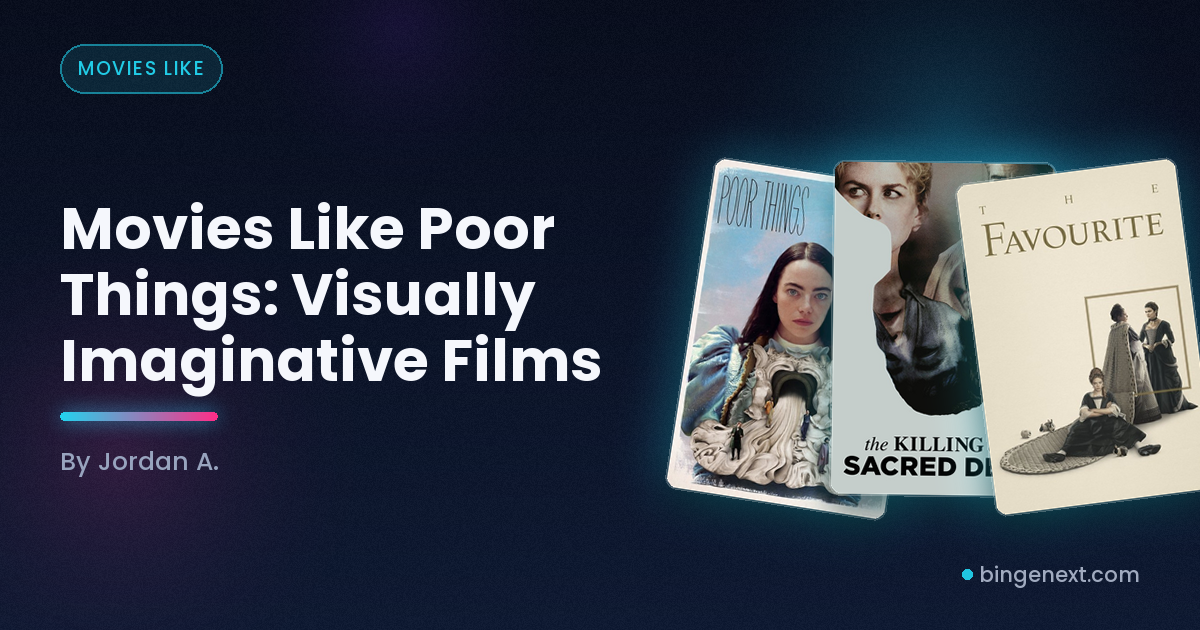
Poor Things does not build a world that looks real. It builds one that is visibly constructed and then refuses to wink about it: painted skies, fisheye lenses, a Lisbon that is obviously a set, color that arrives only when Bella starts choosing things for herself. The artifice is the argument.
So this list is about films that commit to an invented visual world rather than films with a similar plot. Every pick is a feature, and every one made a design decision you can point at. Where each streams changes constantly, so check the title page on BingeNext for current US options.
The rest of Lanthimos
The Favourite (2018) is the obvious companion piece and the best place to start. Same director, same star in Emma Stone, same taste for wide-angle distortion in period rooms lit by candle. It shares the cruelty played as comedy. The difference is that it is set in a real court and constrained by actual history, so the strangeness lives in the lenses rather than the world.
Dogtooth (2009) is the film that made Yorgos Lanthimos's name, though it is not his first feature; that was Kinetta in 2005. Parents raise their adult children inside a walled compound and teach them wrong words for things. It shares the central Poor Things question of what a person becomes when their inputs are controlled. It is flatly shot, deeply unpleasant, and the most direct ancestor of Bella's story. Choose it only if you want the ugly version.
The Lobster (2015) puts single people in a hotel where they must find a partner in forty-five days or be turned into an animal. It shares the deadpan delivery of an absurd rule set. It is Lanthimos's funniest film and also his coldest.
Kinds of Kindness (2024) is an anthology of three stories with the same cast in different roles. It shares the tone completely and the plot not at all. It is the least accessible thing here and rewards patience.
Bugonia (2025) is Lanthimos remaking the 2003 South Korean film Save the Green Planet!, with two men kidnapping a chief executive they believe is an alien. It shares the escalating-absurdity structure. It is more of a thriller than anything else on his shelf.
Worlds built from scratch
Brazil (1985) is Terry Gilliam's dystopia of ductwork and paperwork, and it is the grandparent of this entire mode. It shares the belief that a production designer can make an argument. Every frame is cluttered on purpose. It is longer and messier than Poor Things and the ending is legendarily bleak.
The City of Lost Children (1995), from Marc Caro and Jean-Pierre Jeunet, is a green-and-amber port town where a man steals children's dreams. It shares the storybook-grotesque register almost exactly, the sense of a world assembled from antiques and bad ideas. Choose it if the Lisbon and Alexandria sequences were your favorite part.
The Grand Budapest Hotel (2014) uses miniatures, painted backdrops and three different aspect ratios to signal three time periods. It shares the pleasure of visible construction. It is far lighter in spirit, and it is the friendliest film on this list.
The Fall (2006) is Tarsem Singh's story told by an injured stuntman to a small girl in a 1920s hospital, shot across more than twenty countries with almost no visual effects. It shares the idea that an imagined world should look impossible while being physically real. It is a gorgeous, uneven film and the costumes alone justify it.
Body, texture and unease
Suspiria (2018) is Luca Guadagnino's version, not Dario Argento's, and the two are almost opposites: Argento's 1977 film is saturated primary color, Guadagnino's is drained brown and gray 1977 Berlin. It shares Poor Things's interest in a body being remade by other people's intentions. It is two and a half hours long and genuinely disturbing.
Titane (2021), from Julia Ducournau, is body horror about a woman with a metal plate in her skull. It shares the refusal to explain its own premise and the interest in a body as a site of transformation. It is much more extreme than Poor Things and it is not for a casual evening.
Beau Is Afraid (2023) is Ari Aster's three-hour anxiety odyssey, and its middle act includes a fully animated sequence inside a forest theater production. It shares the picaresque structure of a naive protagonist crossing increasingly unreal territory. It is divisive, and the people who like it like it a great deal.
The Lighthouse (2019) from Robert Eggers is shot in black and white on a nearly square frame with period lenses, which is the most literal example of design as constraint on this list. It shares the sealed-world logic. It is two men, one rock, and a slow collapse.
Where to start
If you want the closest match, watch The Favourite, then The Lobster. If you want the world-building rather than the director, The City of Lost Children, then Brazil. If you want to understand where Bella's story comes from thematically, Dogtooth, with a warning attached. If you want something beautiful you can show other people, The Fall or The Grand Budapest Hotel.
If you would rather skip the sorting, BingeNext for movies takes two or three films you loved and returns a ranked shortlist, each pick carrying a one-line reason for why it is there and where it streams. A run takes about a minute, and the first one each day needs no account.
Topics covered: fantasy, drama, art-film, visually-distinctive, contemporary, indie
About the author
Jordan A., Founder, BingeNext
Jordan A. is the founder of BingeNext and is responsible for every guide published on this site. He built the recommendation engine after one too many nights lost to the streaming menu. Dates, season counts and where-to-watch details in these guides are checked against official sources before publishing, and corrections are welcome at Jordan@Bingenext.com.