Ideas
Why Streamers Keep Canceling Shows After Two Seasons
By Jordan A. · · 4 min read
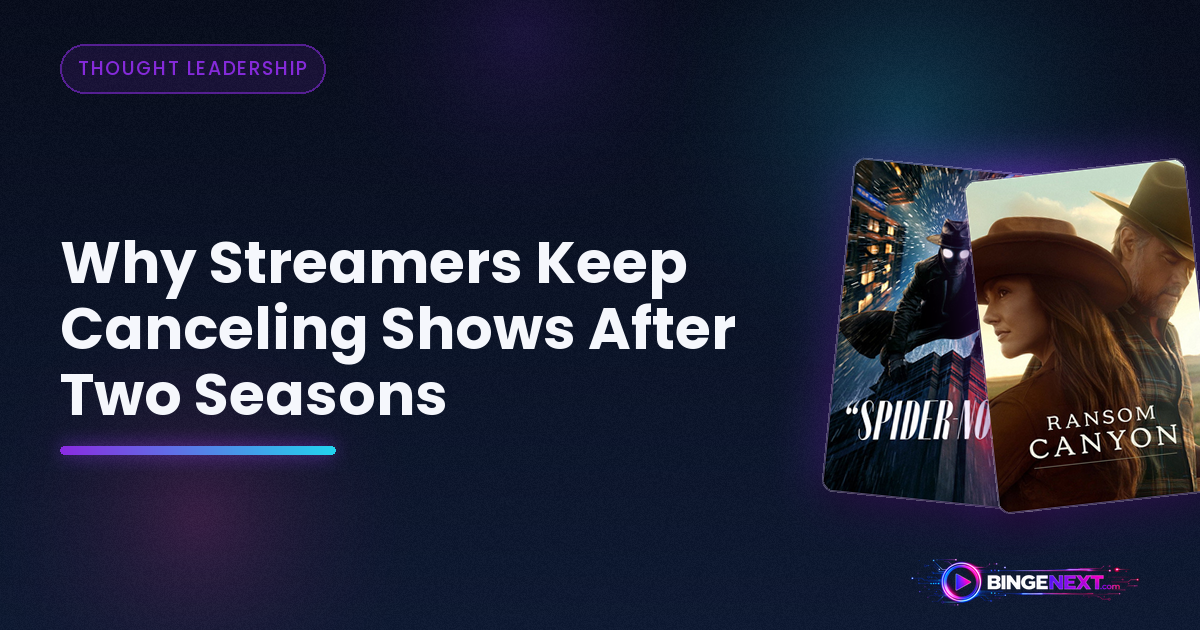
There is a new rhythm to streaming, and it is not a pleasant one. You find a show, you fall for it, and a season or two later it vanishes with no ending in sight. This month handed us the two cleanest examples of the trend yet, one absurd and one quietly familiar, and together they explain why so many series never make it past their early years.
The Spider-Noir paradox
Start with the story nobody could have scripted. On September 4, Prime Video canceled Spider-Noir, the Nicolas Cage superhero series, after a single season. Two days later, at the 2026 Creative Arts Emmys, the same show won five awards off eleven nominations, the most of any Prime Video title that year. It swept the categories that decide how a show actually feels: cinematography, visual effects, stunt coordination, sound editing, and title design.
By any creative measure, Spider-Noir was a hit. It carried a 92 percent critic score and pulled in 2.6 billion viewing minutes in its first six weeks. So why kill it? The answer is money. Reports put the price of the stylized 1930s production near 400 million dollars, and after a huge premiere it slid out of the daily Top 10 fast. Prestige and awards did not close that gap. Cage took the news with grace, telling Deadline that "for me, one season is perfect." He got to end on his own terms. Most shows do not, which is exactly the problem, and it is a big reason so many series finales go wrong or never arrive at all.
Ransom Canyon and the two-season ceiling
The Spider-Noir saga is loud. The more common version is quiet, and it happened the same month. Netflix canceled Ransom Canyon, the Josh Duhamel and Minka Kelly ranch drama, after two seasons. No Emmy circus, no viral cancellation post, just a show with a fanbase that reached the two-year mark and got shown the door.
That two-season ceiling is the pattern worth watching. A first season is a bet. A second season is the audition. If the numbers do not spike in that window, the show rarely gets a third. It is a brutal timeline for stories that need room to breathe, and it punishes the exact kind of slow-building drama that used to define great television.
Why the math changed
Cancellations are not new. What changed is the calculation behind them. In the old model, a network kept a modest show alive because reruns and syndication paid off later. Streaming has no reruns. A series has to justify its cost through new subscribers and retention, and both are measured against a budget that keeps climbing.
Add the industry's growing worry about long gaps between seasons, and the incentive tilts even harder toward cutting bait early. When a show costs a fortune and cannot prove it keeps people paying, the spreadsheet wins over the story. Spider-Noir is what happens when that logic meets an expensive swing. Ransom Canyon is what happens when it meets an ordinary one.
What this means for you
Here is the honest downside for viewers. The two-season ceiling trains people to wait. Why invest hours in a new series if it might get axed before it resolves? That hesitation then becomes the very viewership drop-off that gets shows canceled, which is a loop that feeds itself. It is the reason so many people now cluster around a handful of guaranteed hits instead of taking a chance on something new.
You cannot fix the economics, but you can watch around them. Lean into limited series and anthologies, which are built to end and cannot leave you stranded. Check whether a show is officially renewed before you start a cliffhanger-heavy drama. And when you do love something early, watch it in its first weeks, because that early window is the number that decides its future. The way these companies keep merging and reshuffling their libraries only adds to the churn, a shift we break down in our look at streaming consolidation in 2026.
It is worth being fair to the studios here. Nobody cancels a beloved show for sport, and a 400 million dollar bet that stops paying off is a real problem for a business. The frustration is not that budgets matter. It is that the window to prove a show works has shrunk to almost nothing, and stories that need time to find an audience rarely get it anymore. The old model had patience built in, because a modest performer could still earn its keep for years. The new one runs on a stopwatch, and the stopwatch does not care how good the finale would have been.
The takeaway
Spider-Noir winning five Emmys on its way out the door is the perfect, ridiculous symbol of the moment. Quality is no longer enough. A show has to be a runaway financial success almost immediately, or it becomes a rounding error on a balance sheet. Until that math changes, the smartest move is to watch what you love while it is here, and to keep an eye on the renewal news before you commit your weekends.
Tired of getting attached to shows that disappear? BingeNext can steer you toward series that are complete, renewed, or built to stand on their own. Explore BingeNext and start with something that will not leave you hanging.
Topics covered: tv cancellations, spider-noir emmys, ransom canyon, streaming economics, two-season ceiling
About the author
Jordan A., Founder, BingeNext
Jordan A. is the founder of BingeNext and is responsible for every guide published on this site. He built the recommendation engine after one too many nights lost to the streaming menu. Dates, season counts and where-to-watch details in these guides are checked against official sources before publishing, and corrections are welcome at Jordan@Bingenext.com.