Ideas
Why Network Procedurals Still Win
By Jordan A. · · 4 min read
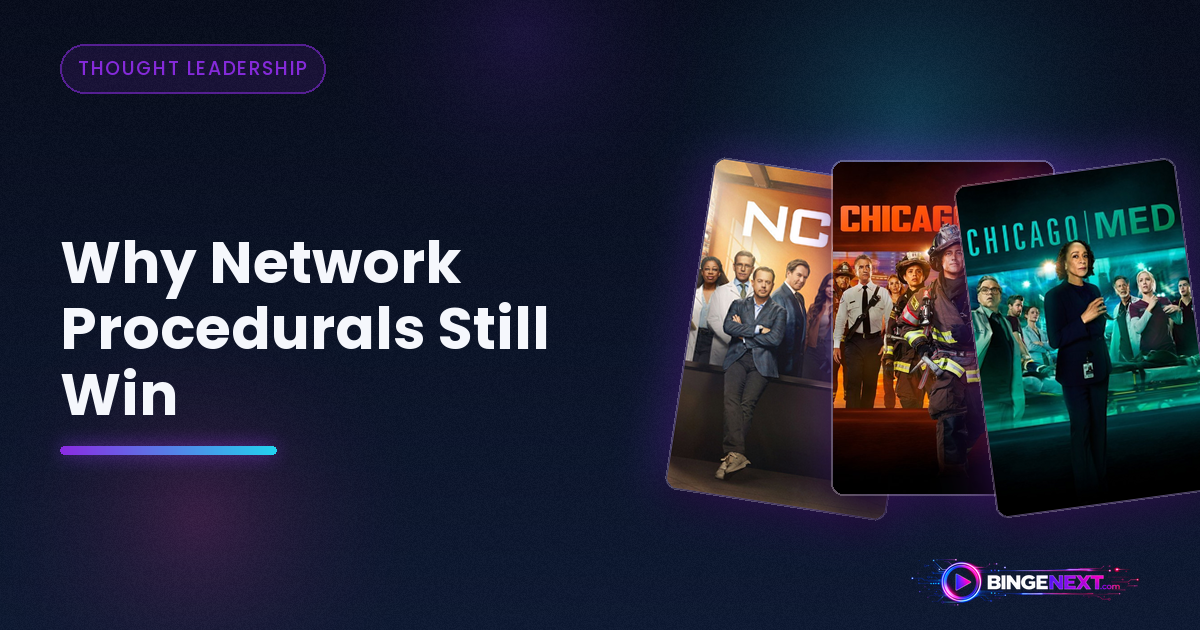
Look at what broadcast television put on the air in the first full week of October 2026. CBS alone brought back NCIS for season 24, launched a new spinoff in NCIS: New York, and returned Tracker, Fire Country, Elsbeth, and Boston Blue. NBC rolled out new seasons of Chicago Med, Chicago Fire, Chicago P.D., the original Law and Order, and SVU in the same stretch. In an era that was supposed to belong to prestige streaming, the humble case-of-the-week procedural is not just surviving. It is the load-bearing wall of the whole fall schedule.
The format that refuses to die
A procedural is a simple promise. A problem appears at the top of the hour, a team of competent people works it, and the problem is mostly solved by the end. Cops, doctors, lawyers, firefighters, it does not matter. The structure is the appeal. You can miss three weeks, come back, and lose nothing. That reliability sounds boring until you remember how most people actually watch television, which is tired, half-distracted, and unwilling to restart a dense serialized drama they abandoned in March.
Why the numbers still favor the network
Streaming trained us to think every show needs a season-long mystery and a cliffhanger. But a serialized show is fragile. Miss the thread and you bail. A procedural is antifragile. It welcomes the casual viewer and the superfan equally, which is why the NCIS brand now spans eight series and the Law and Order family has launched eight official spinoffs since 1999. You do not build an empire that size on shows people feel anxious about falling behind on. You build it on comfort and repetition.
There is a business logic underneath the comfort. A procedural generates a deep library of interchangeable episodes, and that library is gold in syndication and on streaming tiers that need volume. A serialized limited series is a fireworks show. A procedural is a power plant. One is thrilling once. The other keeps the lights on for a decade.
Streaming learned the lesson the hard way
The funny twist is that streamers have started copying the networks. They are rediscovering the weekly release, the self-contained hour, and the franchise spinoff, a shift we dug into when we asked why streaming is bringing back weekly episodes. The same companies that once dumped whole seasons to be devoured in a weekend now stretch their biggest shows out across weeks, because a show you watch for two months is a subscription you keep for two months.
The medical wing of the empire
Medicine is the purest example of why this works. A hospital is a procedural machine, a new patient and a new crisis every hour, and that is exactly why the genre has multiplied the way it has. We traced that boom in our piece on why medical dramas are everywhere in 2026, and this fall only proves the point, with Chicago Med returning for a twelfth season and a slate of new arrivals behind it. The white coat, like the badge and the briefcase, is a uniform the format can wear forever.
What the procedural gives you that prestige cannot
Prestige drama asks for your full attention and your emotional stamina. That is a feature, and the best of it is unforgettable. But you cannot live there. Nobody can watch Severance or The Bear while folding laundry and feel good about it. The procedural is the genre you can actually fit into a real life. It respects that you have a job, a family, and roughly forty minutes before you fall asleep. That is not a lesser kind of television. It is television built for the way people really live.
The franchise as a safety net
The reason networks keep spinning off their hits is that a known format lowers the risk of a new show. Launch NCIS: New York and you inherit a built-in audience that already trusts the rhythm. That is why so many new crime shows arrived this fall wearing familiar brand names. It is not a lack of imagination. It is a smart hedge in an expensive business, and it hands viewers a low-stakes way to sample something new without committing to a cold open from a brand they have never heard of.
So who actually wins
The audience wins, as long as we stop pretending the procedural is the genre we have outgrown. It is the genre we keep coming back to, season after season, because it meets us where we are. The prestige era did not kill the case of the week. It made us appreciate why the case of the week never needed killing. The badge, the scalpel, and the gavel were here before streaming and they will be here after the next format panic too.
The comfort is the strategy
There is a tendency to treat comfort as the opposite of quality, as if a show you can relax into must be a show that asks nothing of you. The procedurals that endure quietly reject that. A great Law and Order hour still lands a moral gut-punch, a strong NCIS case still earns its twist, and the best medical episodes still make you cry in the last five minutes. The format is reliable, but reliable does not mean empty. It means the show does the hard work of being satisfying every single week rather than banking it all on a finale you might never reach. That consistency is a craft, and the networks have spent decades perfecting it while everyone else chased the next prestige swing.
If your watchlist leans prestige and you want a reliable procedural to slot in beside it, that is exactly the kind of balance BingeNext is built to strike across every service you own. Explore BingeNext and let us find the comfort show that fits the life you actually have.
Topics covered: network tv, procedurals, ncis, chicago fire, case of the week
About the author
Jordan A., Founder, BingeNext
Jordan A. is the founder of BingeNext and is responsible for every guide published on this site. He built the recommendation engine after one too many nights lost to the streaming menu. Dates, season counts and where-to-watch details in these guides are checked against official sources before publishing, and corrections are welcome at Jordan@Bingenext.com.